Showing posts with label Historical Sew Monthly 2015. Show all posts

Sunday, September 6, 2015

Historical Sew Monthly #8

Also known as the Norwegian skirt of learning.

My mom is 100% Norwegian. Her father and her mother's mother immigrated here. Her heritage has always had a subtle influence on her, in the foods she eats and the way she decorates her house. After taking a social psychology class and doing a report on cultural beliefs and upbringing, I can see the influence in how I was raised beyond just eating lefsa* at Thanksgiving and pulling the batteries out the smoke detector before making krumkake**. I've always had an appreciation of all things Scandinavian, particularly the everyday art like rosemaling and the embroidery inspired by it.

Which is perhaps why I've had a deep passion for the bunad, the Norwegian national costume.
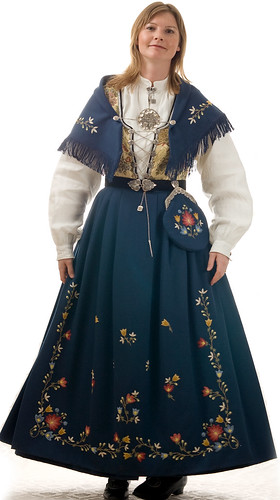
(All images found from simply Googling "bunad")

A few years ago, my Aunt Thelma passed away. I didn't know her (in fact, I'm not sure I ever met her), but I'd always assumed she was one of my maternal grandma's siblings. Grandma came from a large family, so it made sense. My mother was mentioned in Thelma's will, and so a copy of it was sent to her . . . along with a family tree. Thelma was not my grandma's sister, as I'd always supposed. She was the half sister of my grandma's mother, Elise. Apparently my grandma's grandmother was married, widowed, and remarried, resulting in four children total. She also had the most ridiculously awesome name ever: Gunhilde Haldordatter. Gunhilde means "battle maiden" and Haldor is a male name meaning Thor's lightning (datter means daughter, showing linage)***.  With such an amazing name, I've always wondered about her and her life.

I have the clock my grandma's parents got as a wedding gift, and they were married around 1910, I believe. Assuming Elise married at 20, for easy math, that means she was born around 1890, putting Gunhilde as a young adult right through the 1880s using lazy math and assumptions, but it gives me a place to start.

Wikimedia then gave me this:
Christian Krohg - Albertine "to see the police surgeon" created between 1885 - 1887
Ignore all the beautiful bustle era confections going on in this painting, and focus instead on the sad woman being escorted by the police officer into the back, and also on the woman standing on the bench to the far right. Both wear peasant garb, black skirt with or without apron, long sleeve blouse, cross tied shawl, and a head covering. Comparing the waist size and torso shape of the woman with the officer to the fashionable woman in pink, we can tell she is wearing a corset, and is either bustle-less or wearing a very small pad. Her skirt, most similar to what has been copied into the modern bunad, is what I wanted to make. I don't know if this is something Gunhilde ever wore, but it is what I wanted.

Being that are no free patterns for bunads and information on them is extremely limited, I based mine on images around the internet, the fabric requirements from this blog, and this guide for making a dirndl (since they are similer). I used cotton flannel instead of wool, since this was a trial run, and bought 4.5 yards instead of 3.5 because my fabric was narrower. This was my first mistake. That made for far too much skirt and ugly pleating. I also made it for my normal (non-corseted) waist.

I cut off two strips for the waistband, and then cut the rest of the fabric into quarters and sewed the panels together selvage to selvage to make the skirt. (I left a few inches unsewn at the top of one for the opening.) Then I took some gingham remnant I got for a steal and stitched to the waist.
Herringbone stitch to cover raw edges
Modern bunads are cartridge pleated at the back. The gingham with its perfect quarter inch squares became the guide for the pleating.
Up, down, up, down
And pulled tight
The gingham saves you from having to mark the fabric, and provides extra body to the fabric being pleated. The pleating was too deep, and the bottom two rows were removed later. Another problem was not cartridge pleating enough of the fabric. I pleated half of the total skirt, meaning the knife pleats on the front had to be very deep to take up the rest of the fabric. I should have taken another yard at least.

I stitched on the waistband, and was so thoroughly out of love with this project that I will not be hemming it or adding a closure.
From the front (hips!)
Side proves that the woman in the painting wouldn't have needed a bustle pad if the back of the skirt was cartridge pleated.
Close-up of beautiful cartridge pleats
And close-up of ugly knife pleats. The wide box pleat in the front ended up off center because there was sooo much fabric to deal with, and I accidentally put the opening on the right side.

*lefsa is a Norwegian potato tortilla
**krumkake is a crunchy cookie kinda like a pizzelle. I think they taste like a waffle cone.
***Name translations may be wrong, however please don't correct them unless the truth is even more awesome than I believe. :)

The breakdown:
 The Challenge: Heritage and heirlooms

Fabric: 4.5 yards black cotton flannel, black and white cotton gingham
Pattern: My own, based on what information I could find
Year: 1887, but is probably correct for a long range of time periods
Notions: Black cotton thread.
How historically accurate is it? Cotton should be wool, and the hem should have a facing, but it is entirely hand sewn. 60%?
Hours to complete: Somewhere around 20 hours
First worn: Never, and probably never will be, but it was a good learning experience.
Total cost: About $20. The flannel was on sale, the gingham remnant was only about $1 and I had all the thread on hand from other projects.

Sunday, July 26, 2015

Historical Sew Monthly #7

After the stays I made last month, I wasn't done with the fabric. I loved the yellow, with the purple trim, and linen tape, and silk thread and I wasn't entirely ready to give any of it up just because I had completed the project. However, I didn't really have much to work with: some decent scraps of the yellow, just over a yard of the purple bias tape, couple of feet of the linen tape. Suddenly a memory of a blog post I had read came back to me.

A housewife, from Slightly Obsessed 
A housewife is a lovely accessory, adds character to your outfit, and keeps your necessities close at hand. I hate going out in costume without a sewing kit (just in case) and housewife is a period way to keep everything together.


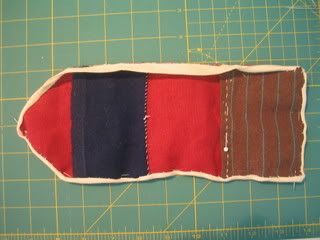
My housewife started out as a 5 in by 14 in rectangle. Seam allowances were added, the top was curved, and four layers were cut. The exterior is the yellow of my stays, there are two pieces of canvas as interlining (one is loose to keep the exterior smooth and one was flat lined to the interior layer to prevent the pockets from causing it to bag), and the interior is simple muslin. First was the pin cushion, which was stitched down, folded over its seam allowance, and basted to the seam allowance on two sides. Then the brown floral pocket. Top edge was hemmed, and then it was basted to the seam allowance. Third, the blue flannel, was edged with a blanket stitch and basted. I also added a seam off-center to divide the pocket in two. The red check, leftover from my bustle era wrapper, was trimmed with the purple bias tape and basted. Then I embroidered my initials onto the outside, put the layers together, and stitched the bias tape to the outside. When I got to the open edge of the pin cushion I stuffed it with scraps of fabric and then continued sewing. At the top I stitched the folded linen tape into the seam for a closure.

I didn't worry about centering my initials, so they're a little off. But on period examples they're usually off-center as well, so I'm not bothered.

Closed. Inside I have my Merchant and Mills black scissors, my tailor's thimble, and some pins and needles. I bought some wood which I cut to make thread winders, but I still have more work to do on those.

The Challenge: #7 - Accessorize
Fabric: Scrap of yellow floral, scrap of cotton canvas, scrap of muslin, scrap of red cotton gingham, brown floral fat quarter, and a bit of some flannel snuggly pants destined for the trash.
Pattern: My own, based on period examples and a tutorial from Slightly Obsessed. 
Year: 18th century
Notions: Silk thread, bias tape, linen tape, embroidery floss
How historically accurate is it? Totally handsewn, which is good. Too much cotton, there should be more linen fabrics in it, and I don't know about the patterns, but using scraps from other projects is completely accurate. Not sure how accurate finishing all the pockets differently is, that was just something I wanted to do. I'll give it 90%
Hours to complete: Started on the 1st, finished on the 3rd, worked about 2 - 3 hours a night. So maybe 9 hours, if we round up? Probably more like 6.
First worn: Not really a wearing thing, but I've been using it since before it was even finished to keep my scissors and thimble close by. 
Total cost: Everything was a scrap or a leftover from a previous project except the brown floral, which was in a bag of vintage sewing notions I got for $10. So the whole piece may have cost me $0.50, of which I only used a small bit.
Now, mid-June I started the project I intended for this challenge: A pair of stockings. I used yarn I had bought previously, and this pattern from Mara Riley to draft my own pattern for my size and gauge and got to work. I knit at a gauge of 9 stitches per inch, completely in the range for period stockings (for wool ones at least), did garter stitch ridges at the top (using the period method of wrap and turn), purl ridge faux seam at the back, three needle bind off heel and toe. The changes I made include slipping the first stitch on every row of the heel flap, which I like better and is easier when it comes to picking stitches for the gussets, and on the second stocking I began decreasing the center of the heel half an inch from bind off. On the first stocking there's a little triangle piece that sticks out from the back of the heel. I'm sure wear will eventually smooth it out, but it bothered me, so on the second I tried to eliminate it with decent success. 
Black wool stockings
These stockings possess the magically property of picking up any and all white lint in the area. But the fit is wonderful.
The Challenge: #7 - Accessorize
Fabric: None
Pattern: Mara Riley's 18th century stockings
Year: Honestly I intend to use these stocking for Renaissance right up through Edwardian, but they'd but most accurate in the 1740s - 1850s
Notions: Three balls of SRK On Your Toes Four ply sock yarn
How historically accurate is it? Yarn might be a bit fluffy, period stockings were made for durability not softness, and this yarn is 25% nylon with aloe vera added. The pattern is perfect, minus my alterations, which are minor. I'm going to say 75%, since the yarn is 25% inaccurate.
Hours to complete: Oh god, lots? The first stocking was mostly done on lunch breaks at work since I was sewing my stays when I got home. The second stocking was my only project and took me 18 days, 2 - 4 hours after work most days and 6 - 8 hours on my days off. Even estimating 3 hours a day that still puts me at triple digits for both, so I'm just going to say 100+ hours.
First worn: For sizing and such. I need to get some ribbon to use as garters so I can actually wear these things.
Total cost: The ball of yarn I had on hand when I started was $13, but when I went back for two more balls it was on sale for $10.80 each, making my total $34.60.

Wednesday, July 1, 2015

Historical Sew Monthly: Out of Your Comfort Zone

Sometime last year I decided to start sewing some 18th century stays. I found lovely fabric, hand-painted thread, 1/8th inch bamboo pieces, and I started sewing. I hadn't even finished the first piece when it struck me: I didn't do a very good mock-up. I don't have enough thread to machine sew it. What if I'm spending hours and hours refining my backstitch only to discover that the stays didn't fit right? I then did what any reasonable person would do: I shoved it in a bag and promptly forgot about it.

Fast forward

Like many, I have been watching Outlander. And like many, I have a favorite dress, the one Claire wears to the Gathering. This one:

From Terry Dresbach's blog
I found a lovely print to use for the petticoat and stomacher (before I realized they were embroidered. Doesn't matter, I'm sure as hell not going to embroider a petticoat.) I also found a beautiful plaid-ish wool for the gown itself. (Posts on both of these fabrics later.) But step one is neither the gown, nor the stomacher, nor the petticoat. Step one is stays. (Okay, technically step one is a shift, but I already have one so I can skip that step.)

I did a bit of research into making stays, and found that the pattern in Costume Close-Up is almost perfectly my size. That pattern is also dated 1740 - 1760, making it the right time period. I copied the pattern, mocked it up, and made adjustments.

Quite a while ago while visiting my parents my mom took me to a garage sale that was getting rid of a ton of fabrics for $1 a yard. I, of course, spent nearly $50 and took home a giant box of fabric. I knew there had to be something in that box I could use for stays. I wanted it to be nice enough that if the stays turned out well I'd like them, but not so nice that I'd regret losing the fabric if they turned out poorly. What I settled on was this:

A creamy yellow cotton with a nice floral pattern. I had a yard length, but not the full width. One side had the selvage but the other side was serged. Stays were likely the biggest thing I could make out of the fabric, and the pattern seemed right to me for the 18th century (I could be very wrong.)

I used two layers of canvas for the interfacing, and machine stitched 1/4 inch channels on every piece. I machined the pieces together, boned them with zip ties, and tried them on again. I had to take in the waist a bit more, but then I finished boning, whipped down the seam allowances, covered the seams in tape, and bound them.

The front. The eyelets are handstitched and set for spiral lacing.

Close-up. The tape over the seams is a natural colored linen with three stripes of yellow running the length. The bias tape is a purple cotton in a gingham print. I wanted purple binding and this is what I could find.

The lining is muslin, hand stitched to the completed stays.

I am not sure how I feel about these stays. I'm not sure about the fit, but I also don't know where to take them in to improve the fit. I also just don't know how to feel about a thing the somehow removes your boobs while maintaining your cleavage. They're weird, they're definitely outside of my comfort zone, and I'm trying not to pass judgement until I've got the rest of the outfit together. (Note: my shift is supposed to have a drawstring for the neckline. I was too lazy to find one, thus the sleeves falling off my shoulders.)

The lacing is purple silk ribbon.

The breakdown:

The Challenge: Out of your comfort zone
Fabric: Yellow cotton quilting for the exterior, cotton canvas for the interior, muslin for the lining
Pattern: Stays 1740 - 1760 from Costume Close-up
Year: 1740s
Notions: Natural and yellow linen tape, purple gingham bias tape, yellow and purple silk thread, white cotton thread, purple silk ribbon, 1/4 inch zip ties, two metal bones by the lacing holes.
How historically accurate is it? The channels were machine sewn, and the seams were also machine, the seam tape and bias tape were sewn by hand, the seams were whipped down by hand, eyelets were hand sewn, pattern was perfect, but the fabric was mostly cotton when linen would have been more accurate. I'd say 40%.
Hours to complete: I'm going to say 40 - 50. A large amount of my days off have gone into this, plus 2 -3 hours every night after work.
First worn: Tonight, for photos
Total cost:  Fashion fabric was $1, canvas was $10, thread was $7, muslin was $1, zip ties were $10, bias tape was $9.50, linen tape was $20, and the silk ribbon was $16.50, making the total: $75. 

Friday, June 5, 2015

Historical Sew Monthly #5: Practicality

So . . . I fell off the radar for a couple of months. Again.

I actually had challenge number three done in time, but kept putting off photos until it became entirely too late to worry about it. #4 I skipped because I was sick and busy. A few weeks ago I realized I still had time for #5, and got to work. I decided to stick with the bustle era since I already had undergarments, thus saving me quite a lot of effort. After pouring over Pinterest I decided to make something similar to the plaid one on the right:

Or this:
From Museum of London
I picked up a nice red plaid, created a pattern (by laying out my bustle bodice pattern and taping the skirt pattern to it to remove the waist seam) and cut pieces. That's when the thought occurred to me: These look comfortable and practical, like you could get stuff done in them, but with no waist seam they take a lot of fabric. What if this is some high class thing and not the comfy robe I make them out to be?

Luckily, a few google searches later and I realized that they were wrappers, to be worn in the morning for breakfast, and completely acceptable to do housework in. Hussah! The dress came together quickly, and worked well with the trim I got when I bought the fabric. I tried to correct the armsyce using the notes I had jotted down previously, but they still need work. The shoulder point is good, but the front needs to be cut down and the back needs more fabric. I had to piece it to get a better fit, but it still needs to come closer to my arm. Anywhoo . . .

I found one wrapper with a v-neckline, which I copied for my own comfort. There will be frog closures down the front, but I haven't gotten around to that yet.

The wrapper is designed to be worn over my corset and bustle.

There is a pouf in the back to give it some interest, and some trim over the seam for the extra fabric.

My favorite part: pockets! There are two pockets, one on either side of the front. They have matching trim and are deep enough to eat my hands up past the wrist! BTW, close up of the trim:

The swoopy one is cotton eyelet and is on the pockets, neckline, back, and all the way around the skirt about 6 inches up from the hem. The bottom one is a satin polyester pleated ribbon with velvet strip right in the middle. That covers the machine stitched hem on the skirt and the cuffs of the sleeves. All in all I am satisfied with how it turned out. The perfect amount of the fancy and plain to be a proper wrapper.
The Challenge: #5 Practicality 
Fabric: Red plaid cotton quilting fabric
Pattern: The bustle bodice and skirt pattern from my Victorian Femme Supernatural Cosplay
Year: 1884ish
Notions: Cotton thread in red and brown, brown cotton eyelet trim, brown polyester ribbon trim, poly-cotton bias binding, brown cording for frog closures (not shown)
How historically accurate is it? Pretty close. I put too much fabric into the bustle portion, but all of the trim ideas came directly from existent pieces. Say 80% for the polyester content.
Hours to complete: 15ish? I didn't keep track.
First worn:  Right now, for because.
Total cost: $50 or so, but there's quite a bit of fabric and trim left over.

Thursday, March 5, 2015

Historical Sew Monthly #2 Blue

So Saturday the 28th the only item I hadn't finished for this challenge was my 1915 jacket, which needed buttons and buttonholes. When I got off work I put on the outfit in order to figure out placement, but I was too tired to actually sew. And considering that the Dreamstress is in New Zealand and I'm in California, completing the challenge the day it's due makes it a day late anyways. So I decide to put it off till Sunday.

Sunday goes fine . . . until about 5pm. I'm at work, and I start feeling sick. Just all over weak and crappy. So when I get home, instead of sewing or hanging with friends, I go to bed. I have a fever so I bundle up in blankets with the plan to burn off whatever this bug is. (My husband tells me this is a bad idea, but I do it anyways.)

Monday I am more sick than I have been in YEARS. No real fever, but the kind of weakness and blood pressure drop that means there is a very real possibility of passing out from simply going to the bathroom because it requires me to be upright for a couple of minutes. I am home alone for most of the day, and have to fight to get downstairs to get water and such. I sleep for most of the day. When roommates do get home I get some soup in me, and some Ibuprofen, and start feeling better. Well enough to go to work Tuesday, but not well enough to make it through my whole shift. I spend the day doing some self care.

Today I'm not totally better and am planning on seeing a doctor. But I also realized maybe I should just make my HSM post and not worry about the damn buttons!

tl;dr: I was sick, so here's a post with the jacket still unfinished.

First up, a Renaissance doublet for a Lady Knight! Front

And back. I decided on sleeveless for movement, time, and heat reasons.

Close-up of the front. Her colors are blue and silver, so the doublet is a blue brocade with silver/grey piping and trim. The patterned band is actually a light blue with silver, gold, and black accents. The closures are metal.

Close-up of back. The trims didn't meet perfectly between the upper and the skirt, but it's not super noticeable in person. The whole thing is interlined in canvas, with some wool padding at the shoulders, upper chest, and back. The skirt and shoulder bits are lined in self fabric and the rest is lined in linen.

Inside of doublet.


The breeches are grey wool with black, blue, and silver trims. The patterned band from the doublet makes it's appearance around the legs.
There is braiding at the lower edge of the waistband, and they lace closed. My "points" are bead caps from Michaels, gently folded around the cord with pliers.
Ground photo of the whole outfit. Flash is angry she isn't really in the picture.
Now Flash is just angry cause she has to stand around in a saddle.
And, of course, a mounted photo. The front of the doublet has a tendency to buckle while seated, so I'll be adding some metal bones to it to keep it smooth. Otherwise, a lap around the ranch showed no issues with the outfit.
The Challenge: #2 Blue
Fabric: Upholstery cotton brocade, cotton duck, wool blend scraps, linen
Pattern: Alter Simplicity 4059
Year: late 16th century
Notions: grey piping, grey braid, light blue patterned ribbon, cotton thread, six metal clasps
How historically accurate is it? Probably more Ren Faire than true Renaissance, but I tried to base the design off of surviving pieces. It is machine sewed and the fabric isn't right. Let's say 20%.
Hours to complete: 25?
First worn: Feb 17, when the photos were taken.
Total cost: Some of this was stash, some was purchase. For just the doublet, probably in the realm of $40
Next up, my 1915 skirt. 
When I decided to make a 1915 outfit I knew I had some fabric I could use for a skirt.
The background floral motif isn't super obvious in person, but the stripes are. I drafted a pattern from a guide from 1912, made up the skirt, and voila!
(The stripes are hard to see in the photo, but picture more stripes, less floral). The skirt has a false crossover front, darted waist, side opening, and these buttons:
They're La Mode Vintage buttons, based off a design used from 1900 - 1919.
The Challenge: #2 Blue
Fabric: Striped, floral, blue cotton (possibly a blend)
Pattern: "Side-Fastening" Skirt, from Thornton's International System of Ladies Garment Cutting (1912)
Year: 1912, but the wider skirts hadn't completely replaced the slim ones, and thus should work for 1915
Notions: Cotton thread, four buttons, hook and eye closures.
How historically accurate is it? The pattern of the fabric doesn't work, stripes are fine but not with the floral added, but otherwise it's solid. 85%
Hours to complete: 6-8, from drafting to complete
First worn: Not yet
Total cost: $10? I had to buy buttons and thread, and I think the fabric was a dollar or two a yard when I got it.
And the jacket. When you see the skirt, you think blue. A grey/blue, but blue none the less. But when you're in downtown L.A. trying to match colors for a jacket, you realize that the fabric is too grey to be blue, too brown to be grey, and too blue to be brown. What I finally found was this:
A greyish blue that is the same dusty hue as the skirt, if not a perfect match to the color. I pulled together resources for making the jacket as the instructions are few, but the sew-along was almost no help either (the steps available are 1: marking, 2: pockets, and 4: the pleated collar. And in case you think I misnumbered, step 3 (which I think is the simple collar, the one I was making) was gone. It was frustrating as one of the reasons I close to purchase the pattern was the extra help the sew-along would provide.) My result:
The striped fabric is used for the tops of the pockets, the collar, the cuffs, and the center of the belt.
Side view for awesome sailor collar
The Challenge: #2 Blue
Fabric: Blue-grey quilting cotton, blue striped floral from the skirt
Pattern: Wearing history's 1916 suit jacket 
Year: 1916, but similar jackets were worn a year eariler
Notions: Cotton thread, 7 buttons, hymo interfacing, linen bias tape to bind the seam allowances.
How historically accurate is it? Except for the stripey floral print and the use of hymo as interfacing, I'd say pretty dang. 90%
Hours to complete: Still not completed, needs button and buttonholes
First worn: Not yet
Total cost: $50, including pattern